
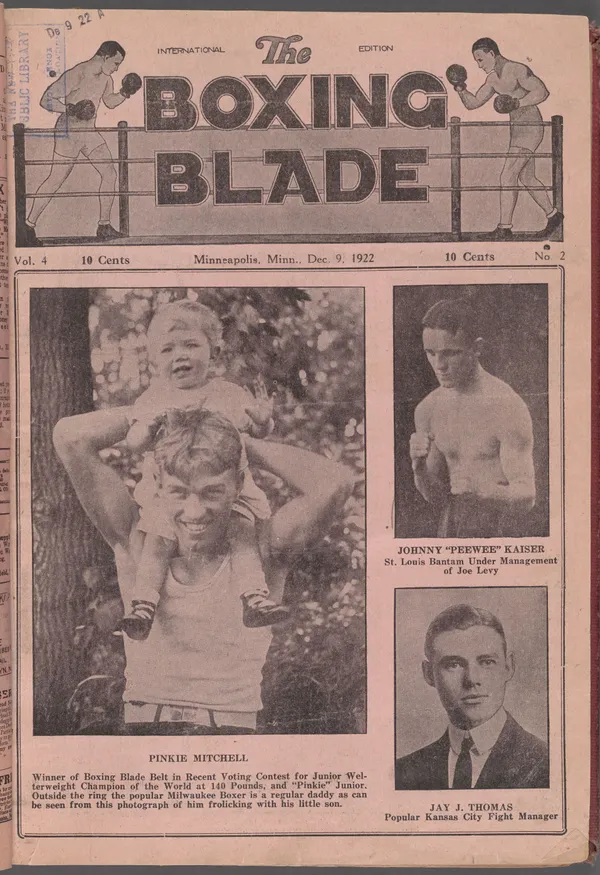
Pages 2–3By Mike Gibbons
Professional Boxer Must Be Good Showman If He Wants to Please All the Fans, Says Mike Gibbons
To Be Successful Drawing Card, Boxer Must Often Change His Style and His Ring Tactics When He Learns That Crowd Doesn’t Like His Usual Methods—Hard to Satisfy All as Some Want Good Boxing and Other Demand Slaughter and Knockout — Fans Should Learn Science of Boxing to Enjoy Game the Most
The St. Paul “Phantom”
The young boxer, beginning his professional career, quickly learns that simply beating his opponent will not insure him the success which brings wealth and an established reputation. Like the actor and the circus performer, a boxer is a showman—and being a showman, he must satisfy his audience.
Boxers who have figured in many hard bouts will, as a rule, admit it was not unusual for them to re-arrange their tactics to suit the fans. It is a well known fact that a number of topnotch boxers would not draw a corporal’s guard in some cities of the United States. The fans, living in these cities, whose likes and dislikes powerfully influence the promoters, don’t want them. An unpleasant incident, a misunderstanding, a poor bout, a dogged determination to fight along certain lines which are not popular, or a dozen other incidents may have been responsible. The boxer won’t draw.
I have often changed my tactics in the ring to suit the crowd. For instance, I could use my right cross most effectively against the jabbing type of boxer. A left lead from a man of this type quite often gave me my opportunity. But suppose my opponent was determined not to lead with his left. Suppose my efforts to get him to do so were making the bout seem rather tame. Is it necessary to say that a change of plan would be vital?
Had to Change Style
It must be done in New York. When I fought my first battles in Manhattan, my style pleased the audience. They seemed to be with me. Unconsciously I tried harder and harder to use the offense methods, and defense methods, which caught the fancy of the fans. They seemed to prefer shifty boxing and they gave me the impression that they came to see a scientific boxing match and not a quick knockout.
After I had boxed a number of times in New York, the fans became accustomed to my style. Then they indicated rather sharply that they wanted something else. After my service as a boxing instructor for the United States army, I realized that the boxing devotees quite generally had shifted to the slashing style of milling, so I changed my methods. This perhaps, caused some of my friends to wonder why I often stood toe to toe with sluggers whom I could have easily outpointed had I elected to box cleverly.
As a rule, boxing fans are far more excited than the men in the ring—provided, of course, the fighters are experienced. A veteran boxer whose mind is concentrated upon his work, seldom hears the volleys of advice, suggestion, and criticism which the crowd pours out, except during clinches and between rounds. But a boxer can quickly sense the attitude of the crowd toward his performance.
Can’t Satisfy All
It may surprise some fans to know that on a few occasions, after I had won contests by quick knockouts, a number of persons came to me and asked why I didn’t give them a run for their money. In January, 1916, when I boxed Ahearn, in St. Paul, a right cross stopped the fight early in the first round. The next day a friend, who had occupied a ringside seat came to me with his tale of woe. It seems that he wore thick glasses and just as the fight started, he took them off to wipe them. “When I got them on again, it was all over,” he complained.
A punch which often is lost to some persons attending a bout is the jolt which travels three or four inches. My suggestion to fight fans who do not believe that vigorous damage can be wrought during clinches, or that a three inch blow cannot have k. o. force, is that they do a little boxing with an experienced glove wielder.
A few years ago, when I was something of a baseball fan, there was a controversy over the various methods of reporting ball games. One faction wanted slangy stories. Another demanded clean cut English. One paper put the issue to a vote. The ball players, with few exceptions, voted for polite English, while quite a number of college professors said they liked the slang.
Tastes Are Different
So it is with boxing. Tastes are varied—and surprising. I know that a lot of fans may take exception to this article but I am going to be honest, not diplomatic. Fight fans have made the game, have ejected the fakir and have eliminated many bad features. But a great many of them have Cave Man ideas and I conscientiously believe that this attitude really deprives them of a lot of legitimate enjoyment.
The thing in a nutshell is science versus crude slugging. Champion boxers are the drawing cards. Cheap sluggers do not pack houses. There is a tremendous lot of science put on exhibition in a good ten round bout—more so, perhaps, than in any other sort of athletic contest. But quite often, the fans hiss and roar for “action.” More than once when this has taken place during a really good bout I have thought: “Why don’t they pay twenty-five or fifty dollars to a couple of husky bricklayers and put on a show in an alley?” Please remember, I am not directing these remarks to the many students of the game who appreciate the fine points.
There are thousands of boxers in the United States. Hundreds of them are powerful fellows whose blows would cuckoo a horse. But only a score of the entire lot are really big drawing cards. What made them drawing cards? Skill, of course. If this is true, why is it that fans will pay their good money to watch these men in action and then protest to the heavens because murder was not committed?
How to Enjoy Bout
When I am in the ring, boxing is a cold business. When I am a spectator it is a thrilling sport. I know that many fans dislike that “slow first round.” To me, it is a wonderful three minutes, provided the headliners are well matched and, by the way, good matches are a vital secret of successful promoting. I have always made it a practice to try to figure out in advance just what style each fellow will use. Then I try to watch them closely as they shake hands. What will this fellow try to do? How will the other boy try to off-set him? Cleverness versus punching ability brings up other interesting problems. The bell rings.
One fellow steps in, feints, and steps back. The opponent tries something. Each, perhaps, found the other prepared. There is evidence that a good fight is impending. They come together again; try different tactics. A blow is slipped, or sidestepped, or blocked. One leads and barely misses receiving a terrific counter wallop. Instantly, he realizes that the punch he used is not safe against that style of a boxer. What will he try next? The bell ends the round. Perhaps neither man has landed a clean blow. Maybe some of the gallery crowd are making caustic remarks. They should be cheering.
The Real Punches
In fairness, however, to the fellows who are many rows from the ring, it is a fact that it is difficult to enjoy a fight unless one is close to the principals. Much is lost to a man sitting way back. The real punches are not the clumsy swings; they are the short, deadly blows. Cleverness can hardly be gauged from a distance. A blocked blow or a slipped punch often cannot be seen more than fifty feet from the ring.
Every fan who has attended a few bouts, knows that a wild swinger hasn’t the slightest idea whether and where his blow is going to land. Almost every fan knows that when two clumsy sluggers meet, one invariably will take a couple of stiff punches and then take ten seconds. It is by no means a secret that the fellow who lands the first wild haymaker generally wins the bout.
Is that boxing? Is that what a majority of fans want? One can hardly blame top-notchers for declaring that some of their best tricks are appreciated only by close followers of the sport. My advice to fans in general, is to banish the thought of a knockout and try to make a mental score of the progress of each boxer. Watch the short, snappy blows. Watch how the man who receives them, acts. Time and again, a short clip on the jaw puts a boxer out on his feet and no one realizes it.