
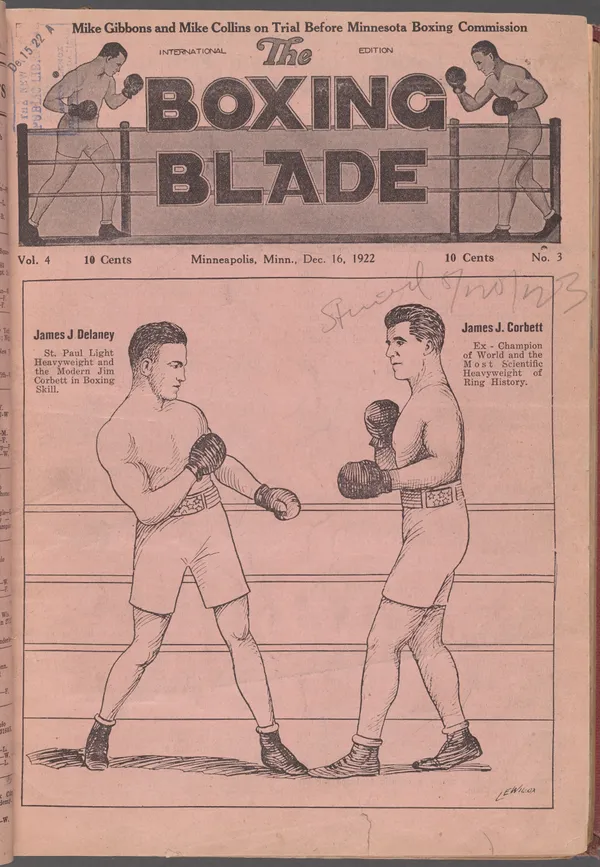
Pages 2–14
Minnesota Boxing Commission Fails to Prove Charges Brought Against Gibbons and Collins
Hearing Called to Investigate Alleged Illegal Show at Albert Lea Turned into Trial of Editorial and News Policy of Boxing Blade When Secretary Sailor endeavors to Show That Editor Is Not Holding Out a Helping Hand to Commission—That Is Another Story, so Blade Brings Out Some Facts and Asks the Commission Secretary to Co-operate in Explaining What the Boxing Law Means and How It Is Enforced
The Minnesota Boxing Commission staged a meeting at St. Paul on Nov. 28th. The object of the meeting was to decide whether the temporary suspension of Mike Gibbons, Mike Collins, Billy Sterns, Mark Moore and Johnny O’Donnell for their alleged connection with an allegel illegal show, held at Albert Lea, Minn., last Nov. 3rd, would be made for two years.
On Nov. 7th, the secretary announced to the world through the daily press that all of the above would be barred for two years. The case came to trial before the Commissioners themselves on Nov. 28th. Bill Sailor acted as prosecutor for the Commission.
The first move made by Sailor was to show that Gibbons and Collins were partners in the management of a stable of boxers. He spent considerable unnecessary time exhibiting stationery put out by Gibbons and Collins. Mike Gibbons quickly settled this matter by stating that no one was trying to prove differently and that he wanted it positively understood that Mike Gibbons and Mike Collins were partners in the management of a big stable of boxers.
Only One Witness for Prosecution.
Sailor called only one witness, Johnny Salvatore, for his side. Salvatore said that he had heard rumors that Gibbons and Collins were handling O’Donnell.
Mark Moore, called in his own defense and as a possible witness against Gibbons and Collins, acknowledged that he boxed at Albert Lea; that he did his own business and that Gibbons and Collins have nothing to do with him; that there was no admission charged; and that the show was staged privately for the Elks. He said he did not know that it was an illegal show or he would not have boxed there.
Johnny O’Donnell was called and testified along the same line, stating that Gibbons and Collins had nothing to do with him or the show.
Then Sailor introduced a letter from the Elks at Albert Lea briefly outlining the said show and stating that no admission was charged; that they did business direct with both O’Donnell and Moore and that Gibbons and Collins had nothing to do with any part of the show or the fighters that boxed there.
The letter also stated that no one by the name of Billy Sterns boxed at Albert Lea that night. Sterns was at Butte, Montana the same day. Sterns was excused but nothing was said about the fact that the unjust temporary suspension of Sterns by the Commission and the story circulated previous to this meeting had done him considerable damage.
Mr. Sailor said his heart bled for both Gibbons and Collins, but he suggested that they be barred for two years. However, in view of the fact that there was no evidence to show that Gibbons and Collins were connected with the alleged illegal show, the commission overruled Sailor’s suggestion and brought in a verdict of not guilty in their case. Moore and O’Donnell were each suspended from boxing in Minnesota for two years, which to many boxing fans seems a drastic sentence for the charge against them.
Sailor worked into the case a part of an editorial written by Mike E. Collins, editor of the Boxing Blade. Sailor endeavored to show that Collins was not co-operating with the commission.
The Editorial Which Hurt.
Following is the part of the editorial which Sailor cited and which he complained about:
Some commissions have been using the National Boxing Association as a hammer to drive boxers in line. The go-between is sent to the boxer, telling him whom he better join, and what he better do or said commission will have him barred, not only in one state but in the United States.
Quite a hammer, and to say the least it generally brings the boxer around to fall in line, according to the politicians’ wishes. A great state of affairs, but they have been getting away with it and then some.
What They Can’t Do
Boxers and managers, here is a little information: No State Commission can bar anyone for any alleged offense outside their jurisdiction. They must have just cause and the defendant must be given a fair and impartial trial (not by a kangaroo court). The complete trial must be sent in writing to the National Boxing Association. And, if the defendant desires, he can appeal his case and have same retried before the national body.
Walter Liginger, chairman of the national body, only a few days ago, expressed the view of the National Boxing Association very plainly, saying that the national body was not or would not be used as a hammer to settle personal affairs for any state boxing commission in the union. The national body is made up of men who are out to boost the game, not for personal gain, but for the good of boxing. They are not out to do any one an injustice, and will not stand for themselves being used for such by anyone else.
The above editorial was based on excerpts of the laws of different states and from information obtained from Walter Liginger, chairman of the National Boxing Association. It was not written to advise anyone to commit a crime, but for the express purpose of curbing any commissions who might unjustly be persecuting anyone in the boxing game.
Furthermore, the above editorial did not refer directly to any particular state but was intended for national application. However, it seemed that the shoe must have fitted Mr. Sailor as he was the one who objected.
As far as the state of Minnesota is concerned, further on in this article we will quote a few excerpts from the Minnesota boxing law as it now stands.
When the commission asks for co-operation with Gibbons and Collins, we wonder just what they mean.
In the course of the trial, Mike Gibbons was told by the secretary that Collins “had it in” for the commission and was “rubbing it in” through the Boxing Blade. Gibbons retorted that Collins had cause to hold no love for the commission, because they had handed him a raw deal in taking the Minneapolis club, for which he had paid money, away from him through no fault of his own but for reasons best known to themselves. One of the commissioners halted Gibbons’ recital of the facts, saying that no boxing club could be bought or sold, that the commission could transfer any club as they saw fit, and that Collins shouldn’t be “sore” at the commission.
Here Are the Facts.
To keep the record straight, here is a history of the boxing clubs in the Twin Cities since the inception of the present boxing law, and also the facts on the deal handed Collins:
The original boxing clubs in the Twin Cities after the enactment of the boxing law, were owned by Louis Dow in St. Paul and Dr. Egan and a Mr. Sweeney in Minneapolis.
In 1916, Harry Sherman and Jack Elliott bought both the St. Paul and Minneapolis clubs, paying $17,500 for them. Sherman and Elliott sold the St. Paul club in 1917 to J. Hilton of North Dakota for $5,000. Hilton’s venture proved very unsuccessful and he abandoned the club in 1918, leaving town for parts unknown. In February of that year, the boxing commission being unable to find trace of Hilton, turned the license for the St. Paul club over to Angus Cameron, who still holds it.
The Minneapolis club was sold in 1917 by Sherman and Elliott to the Snyder brothers, after the former had disposed of some of the stock in North Dakota. The club was later sold to Ernie Potts, who later sold it back to the Snyder brothers. They sold it to Mike Collins in 1918 for a consideration of $3,500. Collins later had to buy up outstanding stock which brought the total cost to him around $4,000.
The present boxing commission one year ago took the club, which was Collins’ rightful property by all moral precepts, away from him without just cause or notice, but merely for political reasons and through a technicality of the law under which the Commission operates and which gives them that power.
Collins purchased the Minneapolis Boxing Club four years ago when the regular shows in Minneapolis were drawing from $800 to $1,500. He worked the business up to where his houses ran all the way from $6,500 to $12,000 per show. Just when the club got built up and in apparent shape to make some money, the present commission held a meeting and, as aforesaid, without warning voted that Collins should turn his club over to someone else.
Collins demanded a reason and was advised that there was no reason; that the commission just gave his club away to someone else, that was all.
Reader, if you want to know how Collins felt about the commission’s way of doing business just imagine some political body relieving you of your business without warning and turning it over to someone else. Or imagine yourself having about $4,000 in cash or property taken from you through no fault of your own and without having anything to say about it. Then, through the ruling of a politically appointed commission imagine that same commission a year later trumping up a case against you without an iota of foundation, and the secretary suggesting a two-year suspension for you,—in other words trying to put you completely out of business.
Well, Reader, we know that if you had a spark of manhood in you, you would feel just as Collins felt. And now they think he should co-operate with them. Is there something else Collins has that they want?
In Game Twenty Years, Never Accused Before.
Mike Collins has been in the boxing game now for about twenty years. During that time he has been a promoter, manager and a writer on boxing, and during the past twelve years he has worked on boxing shows in nearly every state in the Union.
Collins has never yet had to appear before a commission and has never been barred by any commission. Mike Collins was one of the original delegates to the first National Boxing Association meeting at Cleveland in 1915 and he took an active part in the framing and adoption of the original rules of that body, most of which have since been incorporated into the rules of National Boxing Commission of America.
Collins last season managed Mike Gibbons on his come-back that turned out to be one of the most successful come-backs ever attempted by any boxer. Gibbons’ total business for 13 months equalled $130,000.
The above data is cited merely to show that Collins knows his stuff and that he is justified in his feeling towards the commission in question, notwithstanding the fact that they may think they are invested with unlimited power to do almost anything they wish.
But to be fair, perhaps the commission and its secretary think they are doing the right thing, and we will say that if they are sincere and honest in the administration of the law, they must be respected even though their knowledge of the boxing game may be limited. Taking it for granted that they are honest and sincere, and giving them the benefit of the doubt, there are a few things that the commission secretary should explain to the public and do so immediately, inasmuch as he seems to be the official mouthpiece of that body.
First we will give a few excerpts from the Minnesota State Boxing law covering a few of the most important points in question.
“The Commission shall make such rules for the administration of their office, not inconsistent herewith; as they may deem expedient; two of the members of the Commission shall constitute a quorum to do business and the concurrence of at least two commissioners shall be necessary to render a choice or decision by the Commission.”
Sec. 3.—The Commission shall have control over all sparring matches within the state pursuant to its authority and in accordance with the provisions of this act.
Sec. 9.—Provided however that the provisions of this act shall only apply to cities of the first class.
Sec. 9.—Before any license shall be granted to any club, corporation or association to conduct, hold or give any boxing or sparring match or exhibition, such applicant therefor shall execute and file with the state auditor a bond in the sum of five thousand dollars to be approved as to form and the sufficiency of the sureties thereon, by the state auditor, conditioned for the payment of the tax hereby imposed. Upon the filing and approval of such bond, the state auditor shall issue to such applicant for such license a certificate of such filing and approval, which shall be by such applicant filed in the office of the commission with its application for such license; and no such license shall be issued until such certificate shall be so filed.
Sec. 9. The Athletic Commission herein provided for shall not have authority to grant licenses or permit more than twelve boxing exhibitions in any such city during any one year.
Now we come to a few questions concerning the administration of the state boxing law which are being asked by observant boxing fans throughout the Northwest who would like to have them explained.
Isn’t it true that there is no provision in the law giving the secretary of the commission or the commission authority to collect anything from promoters except 10 per cent called state tax?
Isn’t it true that the law states specifically that the commission has no authority to grant licenses for more than 12 shows each year in each city of 100,000 in the state, or to permit more?
Isn’t it true that the Commission permits boxing shows to be staged in St. Paul and Minneapolis by promoters who are not licensed or bonded for $5,000 as required in Section 9 of the state boxing law?
Isn’t it true that the commission has collected from $50 to $100 from each promoter for each show they staged, besides 10 per cent state tax?
Isn’t it true that there has been $25 collected for each show that was pulled off outside the regular licensed clubs where an admission was charged?
Isn’t it true that the Gaeity Theater at Minneapolis last winter ran one boxing show every week under the supervision of the commission and paid $25 each week for the privilege?
How About This?
Isn’t it true that close to 30 shows where admission was charged were staged under supervision of the boxing commission in Minneapolis this year?
Isn’t it true that about the same conditions exist in St. Paul and Duluth?
Isn’t it true that no report of any of this permit money has ever been made to the state of Minnesota?
Isn’t it true that many shows were staged outside cities of 100,000 this season, and that the commission did nothing about it?
Isn’t it true that one of these shows charged an additional state tax of 10 per cent but that the state never received it?
Where Does this Come In?
Isn’t it true that the state law makes no provision for licensing boxers, but that the commission have for the past 12 months charged each boxer $10 as a license fee?
Isn’t it true that the commission or someone connected with it has converted all this money to their or his own personal use without any report to the state?
Isn’t it true that the commission has imposed cash fines on boxers the past few months and that the commissioners have converted this fine money to their own personal use? If not, what has become of the money?
Isn’t it true that the commission some time ago made a rule that no matchmaker or official of any licensed boxing club could manage boxers who worked in shows at his club or at any licensed club in the state?
Isn’t it a fact that this rule has been broken several times in Minnesota and the violation ignored by the commission? If so, why?
Isn’t it a fact that regardless of the charge against a boxer the commission secretary always suggests giving him two years suspension?
Isn’t it true that the commission’s grounds for a case against Gibbons and Collins in regard to the Albert Lea show were concocted to put Gibbons and Collins out of business?
Isn’t it true that Mike Collins wrote the commission for a copy of the commission rules and that body ignored the letter although it was registered?
Isn’t it true that the commission or its hireling said that they were out to get Gibbons and Collins and, right or wrong, they would get them?
Blade Co-operates With Public
The Minnesota Boxing Commission has complained of lack of co-operation in enforcing the boxing law. Co-operation, according to Daniel Webster and other word experts, means working together, or in other words it is not a one-sided proposition. If the commission is sincere in its statement, here is a chance to prove it by co-operating with the public, who want to know if all rules and provisions of the state boxing law are enforced, and if not why not. However, the Boxing Blade is an independent publication and is not pledged to an affiliation with anybody, or anything except that which is for the best interest of boxing. And particularly will the Blade refuse to be tied to any commission, institution, or combination of political origin and continuance. The Blade will continue to give its thousands of readers all the news and facts about boxing without fear or favor.