
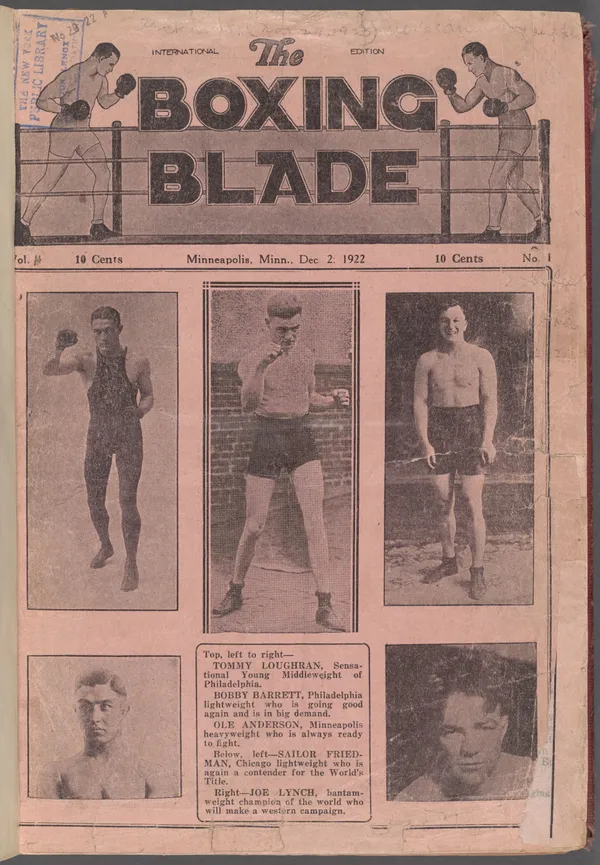
Pages 2–13
Pinkie Mitchell is Elected Junior Welterweight Champion of the World in Boxing Blade Contest
Classy Milwaukee Boxer Gets Over 100,000 Votes in Winning 140-pound Championship and Diamond studded Belt by Popular Selection—More Than Half Million Votes Cast by Boxing Followers from All Over World—National Boxing Association Will Enforce Rules Requiring Champion to Defend Title and Belt Every Six Months Against Logical Contenders.
How They Finished
Final standing of ten leaders in Boxing Blade Contest for Junior Welterweight Champion of the World and the number of votes they received:
| Boxer | Votes |
|---|---|
| Pinkie Mitchell | 100,800 |
| Harvey Thorpe | 60,400 |
| Jack Josephs | 38,100 |
| Battling Krause | 26,000 |
| Eddie Fitzsimmons | 20,200 |
| Ray Jones | 20,200 |
| Sid Barbarian | 17,900 |
| Bud Logan | 10,100 |
| Bobby Harper | 9,000 |
| Jack Foley | 8,400 |
Pinkie Mitchell is the Junior Welterweight Champion of the World, the newest title in boxing.
The popular Milwaukee boxer won the crown for the world’s best 140-pound fighter in a contest conducted by The Boxing Blade.
He has been awarded the Boxing Blade diamond-studded gold belt emblematic of the championship. The belt will be presented to him by the National Boxing Association through Richard T. Burke of New Orleans, chairman of the N. B. A. championship committee.
Mitchell was elected over 20 contestants by votes of boxing followers throughout the world.
At the conclusion of the contest, which ran six months and closed on Nov. 15th, Mitchell had a total of 100,800 votes. He lead his closest rival, Harvey Thorpe of Kansas City, by 40,400 votes.
Thorpe, runner-up to Mitchell, finished with 60,400.
Jack Josephs of Minneapolis was third with 38,100.
Other entries among the first ten and who finished in the following order were Battling Krause, Bismarck, N. D.; Eddie Fitzsimmons, New York City; Ray (Dick) Jones, Minneapolis; Sid Barbarian, Detroit; Bud Logan, Omaha; Bobby Harper, Seattle, and Jack Foley, Chicago.
Votes From All Over World.
A total of 766,000 votes were cast in the contest. They came from all over the globe.
The contest judges were forced to throw out a large number of votes which were sent in, especially early in the contest, for heavyweights, middleweights, regular welterweights and other ineligible boxers. These votes were not allowed because only legitimate junior welters who could make the weight limit of 140 pounds were eligible contestants.
Mitchell’s selection was world wide. His votes did not come from any particular district. Pinkie, and other contestants as well, received votes from admirers as far away as China, Japan, India, South America, Australia and from every country in Europe.
The vote demonstrated a universal interest in the contest and a widespread knowledge of the merits of the contenders for the championship.
The Boxing Blade initiated the contest for the purpose of forming a new class or weight division at 140 pounds. The public was called upon to select the champion of the new class by means of a popular vote.
The object of the junior welterweight division is to give boxers whose best fighting weight is 140 pounds a class of their own and a chance to win a championship in that class. Before the founding of this class, 140-pound boxers were forced to fight out of their weight if they wanted to try for a title. They had to either box lightweights or regular welterweights. If they fought in the lightweight class they were compelled to take off five pounds to make the weight limit and go in the ring in a weakened condition and not able to do their best. If they boxed welterweights they were forced to fight a man outweighing them by seven pounds which was a big handicap. Now, with the formation of the new junior welterweight class at 140 pounds they will be able to fight at their natural poundage, with the added incentive of a title to strive for.
Many Outgrow Lightweight Class.
It is well known that Benny Leonard, lightweight champion, and such contenders as Lew Tendler, Sailor Freedman and Charley White have been taking on weight. It is now common knowledge that they and some other members of the lightweight division fight better around 140 pounds than they do at 136. With the creation of the junior welterweight class, it is probable that the public will soon consider Leonard, Tendler, Freedman, White and others as junior welters and when they are added to the strong field now in the new class what an interesting championship race the division will provide.
Besides aiding the 140-pound boxers, the new class will prove a boon to promoters and the boxing game in general. It will enable promoters to stage more championship bouts and will provide high class matches in a regular class.
It will stimulate more interest among the fans, who will enjoy the efforts of contenders to climb to the throne, just as they like to see the contenders in the other divisions strive for the title.
Another thing to consider in the possibilities of the newly formed class is that 140 pounds is the weight of the average man. Judging from that fact, it is good reason to presume that there will be more good men fighting at the average poundage than at any other.
All in all it looks like the new junior welter division will be the classiest and busiest class of them all.
The National Boxing Association, which comprises boxing commissions of most of the states of the union, and is the biggest and most powerful organized body in control of boxing in the world, was quick to see the benefits of forming a junior welterweight class. The N. B. A. sanctioned the Boxing Blade contest and will recognize the winner as the champion of the division. The National association commended the Boxing Blade for its part in the creation of the new class. Besides giving the contest its approval, the National association has agreed to present the Boxing Blade diamond-studded belt emblematic of the championship to the winner and to enforce the rules governing defense of the belt and the title.
Must Meet Fit Contenders.
According to these rules, the holder of the title must defend it at least once every six months against a logical contender selected by the national authorities, or forfeit the championship and the belt. Such a ruling assures frequent championship bouts, much competition among contenders and a resulting big interest in the class.
A review of the voting in the contest shows that Mitchell took the lead for the last time in mid-October and maintained it to the end. He had been in first place twice previously but had been overtaken by Eddie Fitzsimmons and Harvey Thorpe at different times.
Bud Logan was in front for the first two weeks in June, followed by Sid Barbarian. Mitchell then took the lead for three weeks and lost it to Fitzsimmons. Harvey Thorpe followed Fitzsimmons in the lead but he was replaced by Josephs for the last two weeks of September. Mitchell returned in the first week of October but Thorpe came back and took the lead for the second week. Pinkie then regained it and stayed in front to the finish, Nov. 15, being crowned on that day as the first junior welterweight, 140-pound champion of the world.